

An AI search visibility audit checks whether answer engines can find, understand, and accurately describe your business. For a South Florida business, that means testing relevant customer questions, reviewing the pages behind the answers, and checking whether any resulting visitors become useful inquiries. Start with your actual services and customers, not a promise of guaranteed mentions.
Black Belt Digital Marketing is headquartered in Coral Springs, Florida, and provides AI SEO and answer engine optimization for businesses throughout the United States. The same checks apply in any city. This checklist is a practical starting point for owners who want to understand their current visibility before deciding what to improve.
What belongs in an AI search visibility audit?
A useful audit separates technical access, content accuracy, answer visibility, and lead measurement. Those are different questions. Being mentioned in an answer does not prove your website is generating qualified leads. Likewise, one answer that omits your business does not establish that every searcher will receive the same response.
Google explains that its AI features use the same foundational SEO practices as Search. Pages must be indexed and eligible to appear with a snippet, but meeting those requirements does not guarantee inclusion. Google also says there is no special AI schema or new machine-readable file required for its AI features. See Google’s guidance on AI features and websites.
Use those boundaries to evaluate recommendations. A proposal should explain which real problem it addresses, rather than selling a technical label as a guarantee.
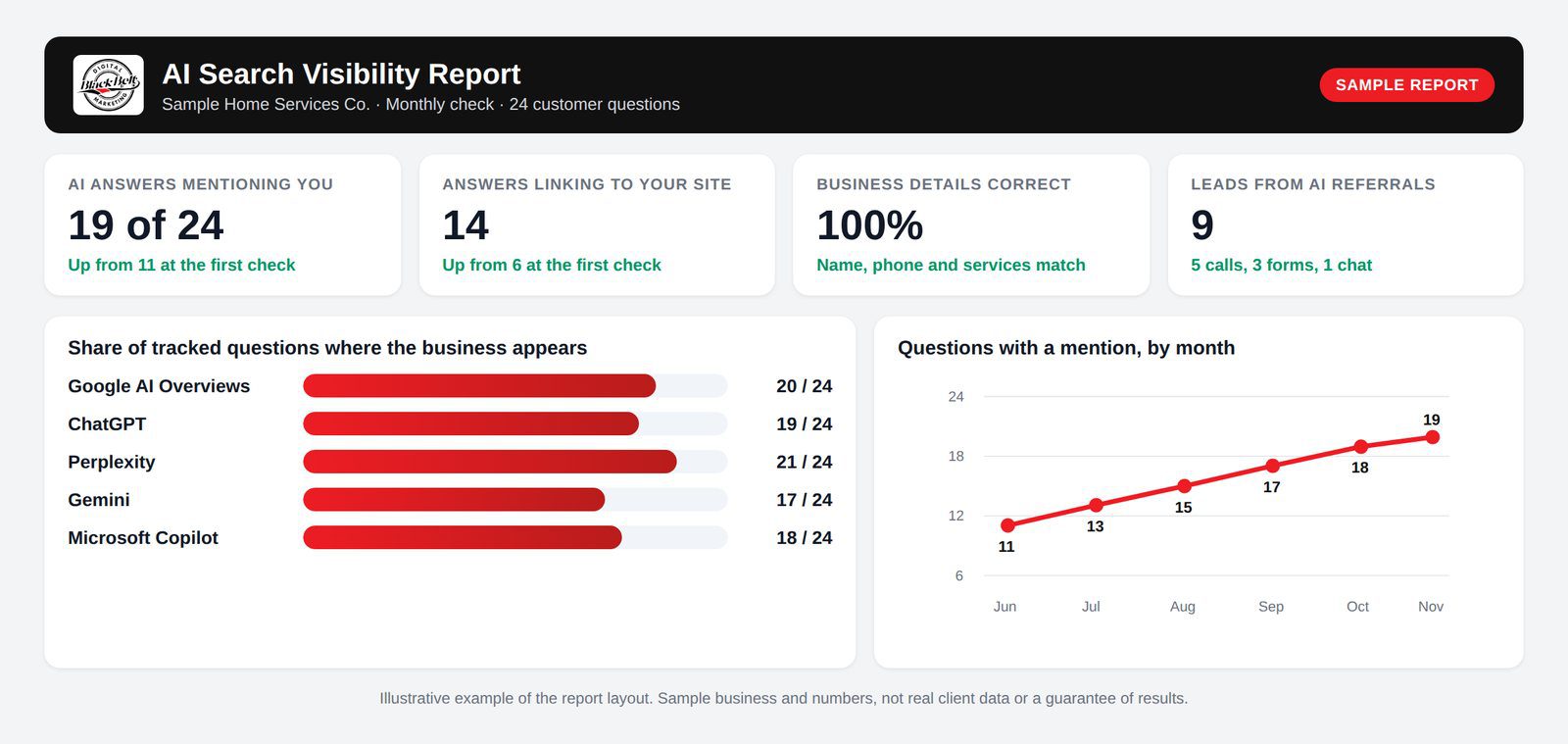
Here is what a monthly AI search visibility audit report can look like. The example below uses a sample business to show how mentions, cited links, accuracy and leads are tracked side by side.
Test questions a potential customer would ask
Choose questions tied to a service, a location, or a buying decision. A Broward County contractor might test searches about its trade and service area. A professional practice might test questions about the type of help it offers. Include your business name to see whether basic company information is described correctly.
- Service discovery: Who provides the service in the market you genuinely serve?
- Buyer questions: What should a customer check before choosing that service?
- Business identity: What does your company do, and where is it based?
- Contact intent: How can a suitable prospect reach the business?
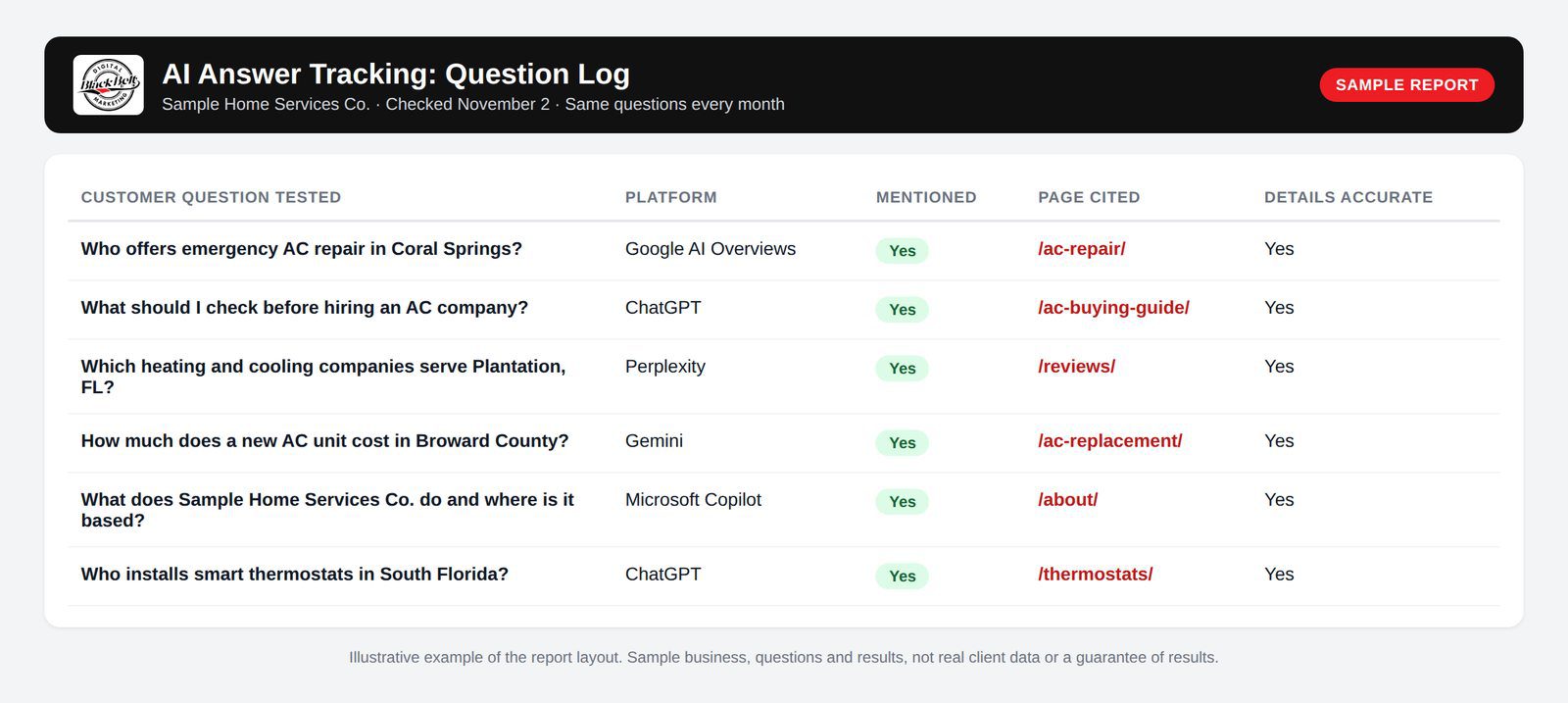
Record the exact question, platform, date, business mentions, and supporting links. Distinguish a complete answer from a search-results list. If a platform blocks the test or asks for verification, mark the result as unavailable instead of treating it as an omission.
Google notes that AI Mode and AI Overviews can use different models and techniques, so their responses and supporting links can vary. Keep that limitation beside your results, as described in Google’s explanation of how AI features work.
Check the pages customers should find
For each important question, identify the page that should answer it. A service question usually belongs on a useful service page. A detailed planning question may deserve an article. Avoid creating a second page that repeats an existing page with a different city name.
Review these basics before adding more content:
- The page loads successfully and is not accidentally marked noindex.
- The canonical points to the intended public page.
- The opening copy states the service, suitable customer, and accurate geography.
- Important information appears as readable text, not only inside an image.
- Internal links connect the page to related services and helpful resources.
- Structured data describes information that visitors can actually see.
These checks connect directly to Local SEO and business profile work and website design and page structure. For context, read our explanations of what Local SEO does and answer engine optimization.
Keep location and evidence accurate
A company can serve customers in Plantation without claiming a Plantation office. State the headquarters separately from the service area. Apply the same distinction when describing Broward County, Palm Beach County, Miami-Dade County, or nationwide availability.
Check that your public name, contact details, services, and business descriptions agree across the website and relevant profiles. Replace vague promises with useful explanations. Use client examples, credentials, reviews, and results only when you have permission and evidence for the specific claim.
If an answer gets your business wrong, record the incorrect statement and examine the linked material. Correct the information you control. Do not assume a single website edit will immediately change every answer engine.
Connect visibility to qualified inquiries
An AI search visibility audit should end with a measurement plan, not only a list of mentions. Decide which actions matter: phone clicks, successful form submissions, consultation requests, or qualified chat conversations. A pop-up opening is an interaction, not the same thing as a completed inquiry.
Test each contact route and confirm that the intended analytics property receives the event. Keep names and definitions consistent so the team can tell a page visit from a lead. Google describes a key event as an event measuring an action important to the business in its Analytics key event guidance.
When source information is incomplete, say so. Ask how the prospect found you and whether the inquiry fits your services. That is more useful than assigning every new lead to AI because a brand mention appeared during a test.
Choose the next fix that matters
Prioritize a broken contact path before polishing a low-value article. Next, fix inaccurate company information or a missing answer on a commercially relevant page. Create a new article only when it serves a distinct customer question and does not duplicate published or planned content.
Keep a short record of the change, its purpose, and what you will check next. Revisit the same questions over time while measuring actual calls, form leads, and useful conversations. No responsible audit can guarantee that an answer engine will recommend a business.
To discuss your website and AI-search priorities, call 888-833-4932, request a free online review, or request a consultation.